
Clinical Studies
Thanks to continuous medical-scientific research, Medicap’s® Biocompatible Artificial Hair Implant, our modern solution to baldness problems or remedy for the unsightly effects of thinning hair, has been perfected in the last decade, to reach a degree of Reliability and Effectiveness appreciated by Doctors and Patients all over the world as also reported in the literature.
Clinical and histological studies at 2, 3 and 5 years attest that Medicap® Biocompatible Artificial Hair has the Quality and Safety standards (biocompatibility, minimum inflammatory reaction, high resistance to chemical, physical and mechanical agents) that make it suitable for implantation.
In addition, greater safety is given by the special Reversible Knot allows, if necessary, an easy extraction of the fiber without scarring.
Below is the opinion expressed by the Authors of Clinical and Histological Studies on the Medicap® Biocompatible Artificial Hair Implant as a remedy for male and female pattern baldness and as a response to the unsightly effects of thinning hair, reported in the Literature:
Clinical Studies
“….omissis …..we believe that hair implant will be more widespread in the future enabling to restore alopecia and scarred areas of the scalp with satisfactorily cosmetic and psychological results”. Evaluation of polyamide synthetic hair. A long-term clinical study , Palmieri B., Griselli G., D’ugo A., Palmieri G., Salti G., Panminerva Med. 2000 March; 42(1):49-53
“….omissis ….. It is a suitable methodology for surgeons, dermatologists and all those doctors who prefer a less traumatic and easier technique to satisfy those patients looking for an immediate aesthetic result….omissis …..”. Implantation of Biocompatible Fibers for the Temporary Correction of Scalp Scars and Androgenetic Alopecia, Morselli M., Palmieri B., Santiago M., International Journal of Cosmetic Surgery and Aesthetic Dermatology 2003; 5(2):175-178
“….omissis ….. These news Polyamide Fiber Implants are well tolerated by the majority of the patients and the Authors agree that this is a possible adjunctive treatment for scalp scars and a viable alternative to nonsurgical solutions (toupees, hairpieces, wigs and similar)”. Artificial Hair Fiber Restoration in the Treatment of Scalp Scars – MA Santiago, R.Perez-Rangel,A. D’Ugo, G.Griselli, G.Igitian, I.Garcia Martin, G.B.Nesheim, Usama Saad Eddin,G.smith, G.W.Brady and C.Chacker. Dermatologic Surgery 2007; 33:35-44)
“….omissis ….. Artificial co-Polyamide Fibre Implantation is a safe, effective, easy and acceptable Hair Restoration Method in Androgenetic alopecia, especially in donor depleted cases” . AGRAWAL M., Modern Artificial Hair Implantation: a pilot study of 10 patients, Journal of Cosmetic Dermatology, 7(4): 315-323, July 3,2008)
Histological Studies
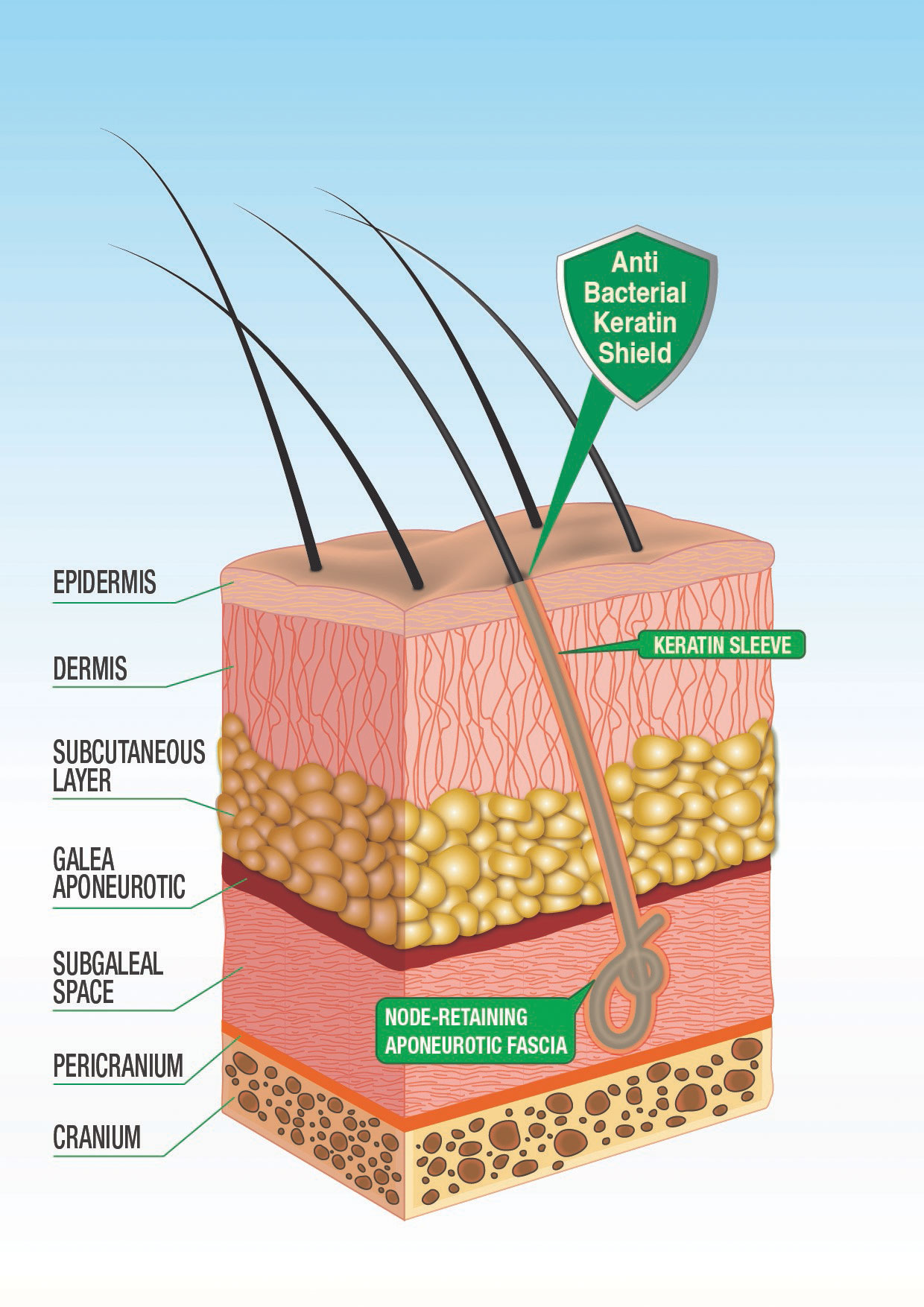
“…Omissis. Our study showed the same modifications in patients without inflammatory complications as in patients with inflammatory complications, except for the presence of inflammatory infiltrates. In our cases, the density of the fibres was lower than found in patients with cutaneous complications, in particular the fibres were surrounded by closely adhering sleeves of keratin at the level of the pseudo-infundibula.
This aspect was absent in cases with inflammatory complications. In conclusion, if the hairs are implanted at low density and the physical and chemical characteristics of the fibre allow the adherence of a sleeve of keratin inside the pseudo-infundibulum, it is possible that no clinically evident inflammatory complications will appear”. Fanti P.A., Pistorale T., D’urso C., Misciali C., Tosti A., Histological study on 5 cases of patients who underwent artificial hair implantation without complications, XXXII Annual Meeting, American Society of Dermatopathology, New Orleans, USA, February 01-03, 1995
“….omissis ….. Implantation of Artificial Hair (Biofibre® CE 0373/TGA ) can be considered as the only alternative to treat Hair Loss for Women having severe rarefaction. The modest entity and nature of the phlogistic reaction gives credit to a high degree of biocompatibility of the fibers under examination. Rejection rate observed after pre-implant tests is acceptable (2%) and was completely solved by integrally extraction the fibers” Santiago M., Histological study of the scalp implanted with polyamide artificial fibers (Biofibre® CE 0373/TGA). Analyses after 5 years , International Society of Hair Restoration Surgery, 10th Annual Meeting, Chicago, USA, October 9-13, 2002
Would you like to learn more about the Biofibre® technique?
Contact us if you are a physician interested in training, a patient looking for solutions against baldness, or a distributor who would like to partner with us.